 By Editorial Team
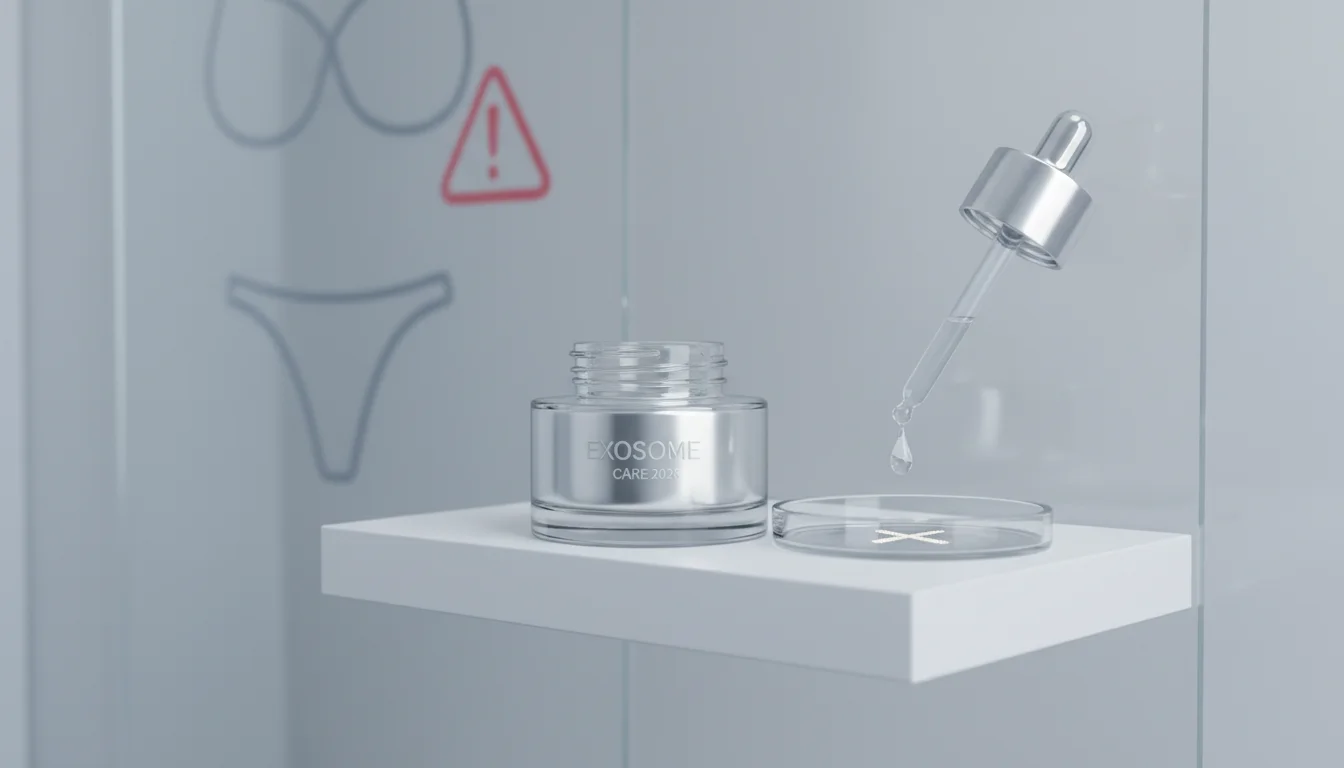
2026 saw a wave of new skincare ingredients hit the market, with promises ranging from deep hydration to full-on cellular regeneration. Exosomes got a ton of attention, especially in regenerative aesthetics. But when it comes to exosome safety, particularly for sensitive spots like the bikini area, you have to cut through the hype. These novel biological components come with a real risk of unforeseen problems.
Key Takeaways
- Exosomes are basically tiny mail carriers between cells, filled with proteins, lipids, and nucleic acids that tell other cells what to do, which is why they’re tied to regeneration.
- The real safety question for any exosome product isn’t the exosome itself, but where it came from and how well it was purified and sterilized.
- Because government oversight for cosmetic exosome products is still being figured out, the quality and the claims you see on bottles are wildly inconsistent.
- You have to check the exosome source (is it from fat-derived stem cells, umbilical cord blood, or something else?) and demand to see third-party testing docs for purity and sterility.
- When it comes to bikini care, stick with products that have transparent ingredient lists and run from anything making wild medical claims or being shady about its exosome source.
This new trend landed squarely in the lap of Dr. Evelyn Reed, a dermatologist in Atlanta, Georgia. Her practice, located near the busy corner of Peachtree Road and Lenox Road in Buckhead, has always been known for picking up effective new treatments backed by good science. But the sudden flood of patients asking about exosome treatments for everything from facial skin to soothing a post-wax bikini line was a different kind of challenge. “We started seeing ads for exosome serums everywhere,” Dr. Reed said at a recent medical conference down in Savannah. “Patients were coming in with printouts from beauty forums, asking if we did ‘exosome facials’ or if they could use some ‘exosome aftercare’ on their more delicate skin.”
The problem wasn’t just the hype, as Dr. Reed soon found out. It was the complete lack of solid, consistent information. So many of these products were sold with vague promises, hinting at regenerative powers without getting into the science or, more importantly, their safety checks. Her concern grew after a longtime patient, Sarah Jenkins, asked about an exosome-infused serum she’d bought online for her bikini line. Sarah was always careful about using natural ingredients but had been dealing with nagging irritation after her professional waxes. She was hoping this expensive new serum was the answer. “It promised ‘cellular repair’ and ‘reduced inflammation’,” Sarah said during her appointment, showing Dr. Reed the sleek, minimalist bottle. “But when I looked at the label, it just listed ‘exosome complex’ and nothing else.”
That kind of vagueness is a huge red flag, according to Dr. Reed. Exosomes are tiny extracellular vesicles, messengers released by cells that carry proteins, lipids, and genetic material to communicate and help with tissue repair. The scientific world has been looking at them for serious medical uses, like in cancer therapy or regenerative medicine. But making the jump from a controlled clinical study to an over-the-counter cosmetic product introduces a ton of variables, especially around where they came from and how they were processed. “The origin of the exosomes matters immensely,” Dr. Reed stressed. “Are they plant-derived? Human-derived? If they’re from human cells, which ones? Adipose-derived stem cells? Umbilical cord blood? Each source has completely different implications for how well it works and, more to the point, for safety and purity.”
Feel smooth and ready, wherever the day takes you
Gentle, expert waxing that leaves you smooth for weeks. Find a trusted studio near you.
Find a Studio Near You →Exosome products are almost always marketed for their regenerative properties. Proponents claim they reduce inflammation, speed up healing, and improve skin texture. These claims are obviously very appealing for sensitive areas like the bikini line, where irritation and ingrown hairs are a constant battle after waxing. The problem is, the actual scientific proof for these cosmetic benefits from a topical application, especially from a non-medical-grade product you buy online, is pretty thin and rarely backed by independent, peer-reviewed studies. “There’s a world of difference between exosomes used in a controlled clinical trial for a specific disease and a serum you buy off a website for cosmetic use,” pointed out Dr. David Chen, a molecular biologist at Emory University’s School of Medicine whom Dr. Reed consulted. “The regulatory paths aren’t even close, and the level of testing for contaminants, immune reactions, and stability is often not comparable at all.”
For Sarah, the exosome serum seemed to work at first. She used it every day for a week after her wax. For the first few days, the redness seemed a little better. But by day five, a mild, itchy rash started to appear. Worried, she stopped using it and booked it back to Dr. Reed’s office. “The rash wasn’t terrible, but it was definitely new,” Sarah said. “And it was right where I’d been putting the serum.”
Dr. Reed’s exam confirmed it: contact dermatitis, almost certainly triggered by something in the serum. The whole incident perfectly illustrates the core issue of exosome safety in an unregulated cosmetic market. Without clear labels on the exosome source, the purification methods, and any other additives, consumers are basically just gambling with unknown biologicals. “The biggest risk isn’t always the exosomes themselves, but what’s tagging along with them,” Dr. Reed explained to Sarah. “Contaminants from sloppy sourcing or processing, leftover growth factors that could trigger unwanted cell activity, or even just the preservatives and fragrances in the formula. Any of those could be the irritant.”
Regulation for exosome products is brand new. In the U.S., the FDA has put out guidance on human cells, tissues, and related products (HCT/Ps), which covers some exosome preparations. But many cosmetic products with exosomes can slide into a much less regulated category, where the manufacturers don’t have to prove safety or effectiveness before they start selling. This leaves consumers in a gray area where they have to be extremely careful. “I tell my patients to always ask for proof of third-party testing,” Dr. Reed said flatly. “You want to see certifications confirming the absence of pathogens, endotoxins, and heavy metals. Any decent manufacturer will have this documentation ready to go.”
Another thing is that the concentration and viability of exosomes in these cosmetic products are often a total mystery. A label might say it has exosomes, but it gives you no clue how many, whether they’re even intact, or if they have any biological activity left. Without any standardization, you can’t really judge how well a product works or compare it to another one. “It’s like buying a vitamin supplement that just says ‘vitamins’ on the bottle without listing the types or the dosages,” Dr. Chen added. “You have no idea what you’re getting.”
In the end, Dr. Reed told Sarah to ditch the exosome serum and go back to basics with a simpler, professionally recommended aftercare plan for her bikini area. She suggested focusing on hypoallergenic, fragrance-free products made to soothe and hydrate, along with a gentle exfoliant with salicylic acid to keep ingrown hairs at bay. A few days later, Sarah’s rash was gone and her skin was back to normal. “Lesson learned,” Sarah admitted. “I was so ready for a quick fix that I didn’t stop to think about what I was actually putting on my skin.”
Sarah’s story is a perfect example of why you have to be smart when trying new ingredients, especially complex biological ones. When you’re dealing with an area as sensitive as the bikini line, where the skin is already prone to getting irritated and inflamed, the stakes are just higher. Consumers need to demand transparency from manufacturers and ask tough questions about sourcing, purification, and independent testing. If a product’s promises seem unbelievable or the ingredient list is fuzzy, it’s a sign you need to do more digging. “It’s our job as practitioners to educate our patients,” Dr. Reed concluded. “And it’s on consumers to be their own best advocates, especially when you’re talking about new ingredients that haven’t been around long enough for solid regulation.”
Sure, the idea of regenerative ingredients like exosomes is exciting. But for sensitive areas like the bikini line, caution and a healthy dose of skepticism are your best friends. Stick to products with transparent sourcing, clear science, and safety data you can actually verify. For other post-waxing options, you could try something like Aveeno Oat post-wax comfort, or if your skin is extra sensitive, look into eczema-safe waxing aftercare. It’s also worth reading up on what dermatologists are saying about exosomes for waxing aftercare to get a more balanced view of their potential.
What exactly are exosomes and how are they used in skincare?
Exosomes are microscopic vesicles that cells release to send messages, carrying proteins, lipids, and genetic material, to other cells. Skincare companies are putting them in serums and topicals, marketing them as a way to trigger cell regeneration, calm inflammation, and generally improve skin repair.
What are the main safety concerns regarding exosome products for bikini care?
For bikini care, the safety concerns are all about the source (is it human, plant, and from what kind of cell?), the purity (is it free of contaminants, pathogens, or unwanted growth factors?), and the risk of an allergic reaction from unknown ingredients or bad processing. The lack of solid regulation for many cosmetic-grade products is a big part of the problem.
How can I verify the safety and efficacy of an exosome product before using it?
You need to ask about the exosome source and demand to see documentation from third-party labs that tested it for purity, sterility, and contaminants. A good rule of thumb is to stick with reputable brands that are transparent about their ingredients and can point to some real science behind their claims. If the info is vague, be suspicious.
Are there specific ingredients or certifications I should look for in exosome products?
Certifications specifically for cosmetic exosomes are still in their early days. For now, look for signs that the product was made under Good Manufacturing Practices (GMP). You also want to see any lab reports confirming it’s free of allergens, heavy metals, and bacteria. A company that’s upfront about the specific cell type the exosomes came from is usually a good sign.
What alternatives are there for sensitive bikini area care if I’m concerned about new ingredients like exosomes?
If you’re wary of new stuff like exosomes, just stick to the classics for sensitive bikini care. Go for established, hypoallergenic, and fragrance-free products. Soothing and hydrating ingredients like aloe vera, chamomile, colloidal oatmeal, or hyaluronic acid are great choices. A gentle exfoliant, like one with salicylic acid, can also be carefully used to help prevent ingrowns.


